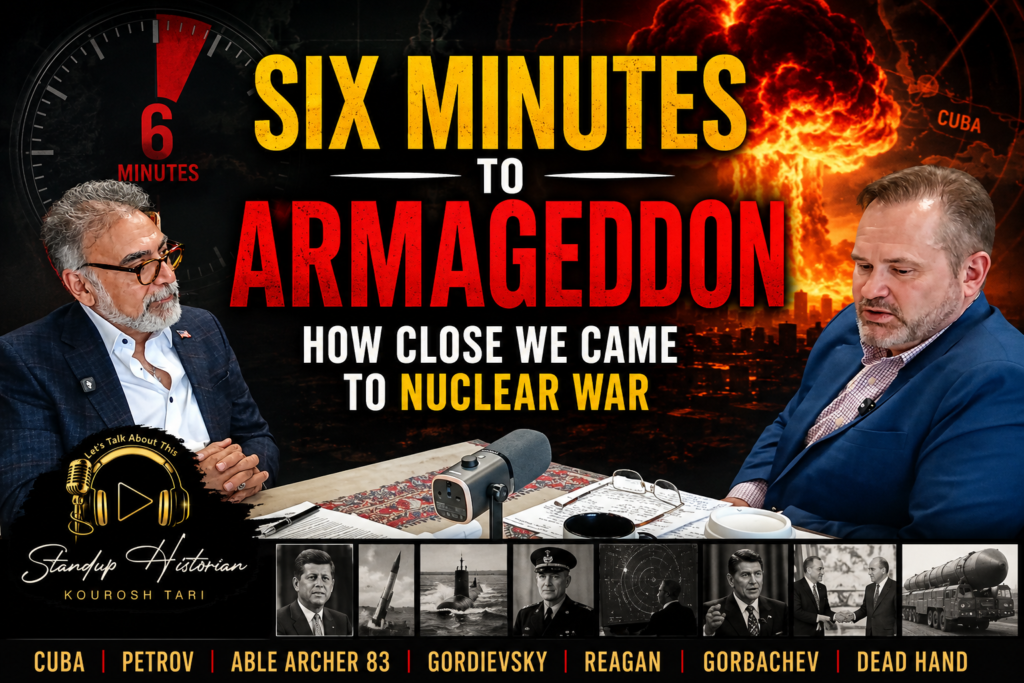
The Cuban Missile Crisis: Espionage, Miscalculation, and the Men Who Helped Prevent Nuclear War
Exploring the pivotal moments that shaped the Cold War.
The shadows of the Cold War are long, and the Cuban Missile Crisis stands as one of its most intense moments. In this episode of Stand Up Historia, we delve into the intricate web of espionage and paranoia that characterized this critical period.
Behind the Illusion of Soviet Power
During the Cold War, appearances mattered enormously.
At military parades in Moscow, the Soviet Union displayed weapons designed to project an image of overwhelming military power. To observers in the West, Soviet missile capabilities could appear formidable and perhaps even superior to those of the United States.
But intelligence was beginning to reveal a different picture.
American U-2 reconnaissance aircraft provided Washington with invaluable information about Soviet military capabilities. Intelligence gathered from inside the Soviet system also helped American policymakers understand what the Soviet Union could—and could not—actually do.
That knowledge became extraordinarily important when another U-2 flight produced photographs showing something unmistakable:
The Soviet Union was secretly installing nuclear-capable missiles in Cuba.
For President John F. Kennedy, the discovery presented an enormous strategic problem. Soviet nuclear weapons positioned only about 90 miles from Florida could dramatically reduce warning time and alter the nuclear balance.
Kennedy now had to respond without accidentally starting the very war he was trying to prevent.
Oleg Penkovsky: The Spy Behind the Crisis
One of the most consequential intelligence sources of the period was Colonel Oleg Penkovsky, a senior Soviet military intelligence officer who secretly provided information to Western intelligence.
Penkovsky supplied the West with extensive information about Soviet military doctrine and missile technology.
When American intelligence analysts examined the U-2 photographs from Cuba, information supplied by Penkovsky helped them better understand the weapons they were seeing and their capabilities.
This is one of the fascinating dimensions of the Cuban Missile Crisis.
Kennedy was confronting Khrushchev publicly, but behind the scenes an intelligence war had already been underway for years. Information obtained through espionage was helping American leaders understand the military reality hidden behind Soviet secrecy and propaganda.
Sometimes history turns not only on armies and presidents, but on information.
Kennedy Faces an Impossible Choice
Once the missiles were discovered, Kennedy faced several possible responses.
The United States could launch airstrikes against the missile installations. It could invade Cuba. It could attempt diplomacy. Or it could establish a naval blockade—officially described as a “quarantine”—to prevent additional Soviet offensive weapons from reaching the island.
Every option carried enormous risks.
An American attack on Cuba could kill Soviet personnel, forcing Khrushchev to respond. A Soviet response against American or NATO forces in Europe could then provoke further retaliation.
Step by step, a conventional confrontation could become a nuclear war.
Kennedy ultimately chose the naval quarantine while simultaneously opening channels of communication with Moscow.
But events were rapidly developing beyond the complete control of either Kennedy or Khrushchev.
And that may be the most frightening lesson of the Cuban Missile Crisis.
The two leaders were not controlling every ship, aircraft, submarine, commander, or weapon involved in the confrontation.
Alexander Feklisov and John Scali: Diplomacy Outside Official Channels
As Washington and Moscow searched desperately for a way out, an extraordinary back channel emerged.
Alexander Feklisov, an experienced Soviet intelligence officer stationed in Washington, met with American journalist John Scali of ABC News.
Their conversations became part of an unofficial channel through which possible terms for ending the confrontation could be explored.
The idea was essentially straightforward: the Soviet Union could withdraw its missiles from Cuba, while the United States would publicly pledge not to invade Cuba.
Behind the scenes, another sensitive issue involved American Jupiter missiles stationed in Turkey.
These unofficial contacts demonstrate something important about international crises: diplomacy does not always occur across polished conference tables.
Sometimes communication happens quietly, indirectly, and through people who may never receive the historical attention given to presidents and generals.
Beneath the Atlantic, Another Crisis Was Unfolding
While Kennedy and Khrushchev exchanged messages, something even more dangerous was happening beneath the ocean.
Soviet submarines had been sent toward Cuba. Among them were vessels carrying nuclear-armed torpedoes.
American naval forces enforcing the quarantine were attempting to locate Soviet submarines and force them to surface.
The Americans used signaling depth charges against Soviet submarines.
But inside one of those submarines, B-59, conditions were deteriorating.
The submarine had been submerged for an extended period. Communication with Moscow was limited. Temperatures inside were extremely high. The crew did not have a clear understanding of what was happening above them.
They knew American ships were nearby.
They heard explosions.
And they did not know whether war had already begun.
Vasili Arkhipov and a Decision That May Have Saved the World
Aboard B-59 was Vasili Arkhipov, a senior Soviet naval officer.
Under the extraordinary pressure of the confrontation, the submarine’s captain considered using its nuclear torpedo.
Had a nuclear weapon been fired against an American naval vessel, the consequences are almost impossible to calculate.
The United States might have interpreted it as the beginning of a Soviet nuclear attack. American forces could have retaliated. Moscow might then have responded.
The escalation could have become unstoppable.
Arkhipov opposed launching the weapon.
His judgment helped prevent the confrontation beneath the Atlantic from becoming a nuclear exchange.
Decades later, former U.S. Secretary of Defense Robert McNamara reflected on how little American officials understood at the time about the nuclear danger they were confronting.
The significance of Arkhipov’s decision has consequently become one of the most extraordinary stories of the Cuban Missile Crisis.
One man, inside a submarine beneath the ocean, faced with incomplete information and enormous pressure, helped prevent a decision that could have changed human history.
The Crisis Ends
Eventually, Kennedy and Khrushchev found a way out.
The Soviet Union agreed to remove its nuclear missiles from Cuba.
The United States publicly pledged not to invade Cuba and, in a separate understanding, later removed its Jupiter missiles from Turkey.
The immediate crisis ended.
The world survived.
But survival should not be confused with inevitability.
The Cuban Missile Crisis did not end peacefully because nuclear deterrence worked perfectly or because every leader possessed complete information.
Quite the opposite.
Again and again, misunderstandings, technical limitations, military procedures, political pressures, and individual decisions pushed events toward escalation.
Human judgment pulled them back.
The Most Important Lesson of October 1962
More than six decades later, the Cuban Missile Crisis remains profoundly relevant.
It is tempting to look backward and assume that because nuclear war did not happen, it was never really going to happen.
That is a dangerous way to read history.
The people living through October 1962 did not know how the story would end.
Kennedy did not know everything Khrushchev was thinking. Khrushchev did not control every Soviet commander. American forces did not always know whether Soviet actions were deliberate or accidental. Soviet officers did not always understand American intentions.
And beneath the Atlantic, men aboard a submarine had to decide whether the explosions surrounding them meant that World War III had already begun.
History sometimes turns on enormous forces—ideology, economics, armies, empires and technology.
But sometimes it turns on a single human being who, at precisely the right moment, decides not to pull the trigger.
The stories of Oleg Penkovsky, Alexander Feklisov, John Scali and Vasili Arkhipov remind us that espionage and diplomacy were not side stories of the Cuban Missile Crisis.
They were part of the reason humanity survived it.
And perhaps that is the enduring lesson of October 1962: when nations possess the power to destroy one another, restraint is not weakness.
Sometimes restraint is the most consequential act of courage.
Watch the full episode of StandUp Historian Channel on YouTube for our deeper conversation about the Cuban Missile Crisis, Cold War espionage, nuclear deterrence, and the individuals whose decisions helped keep the Cold War from becoming World War III.Missile Crisis and its implications, check out the full episode of Stand Up Historia.