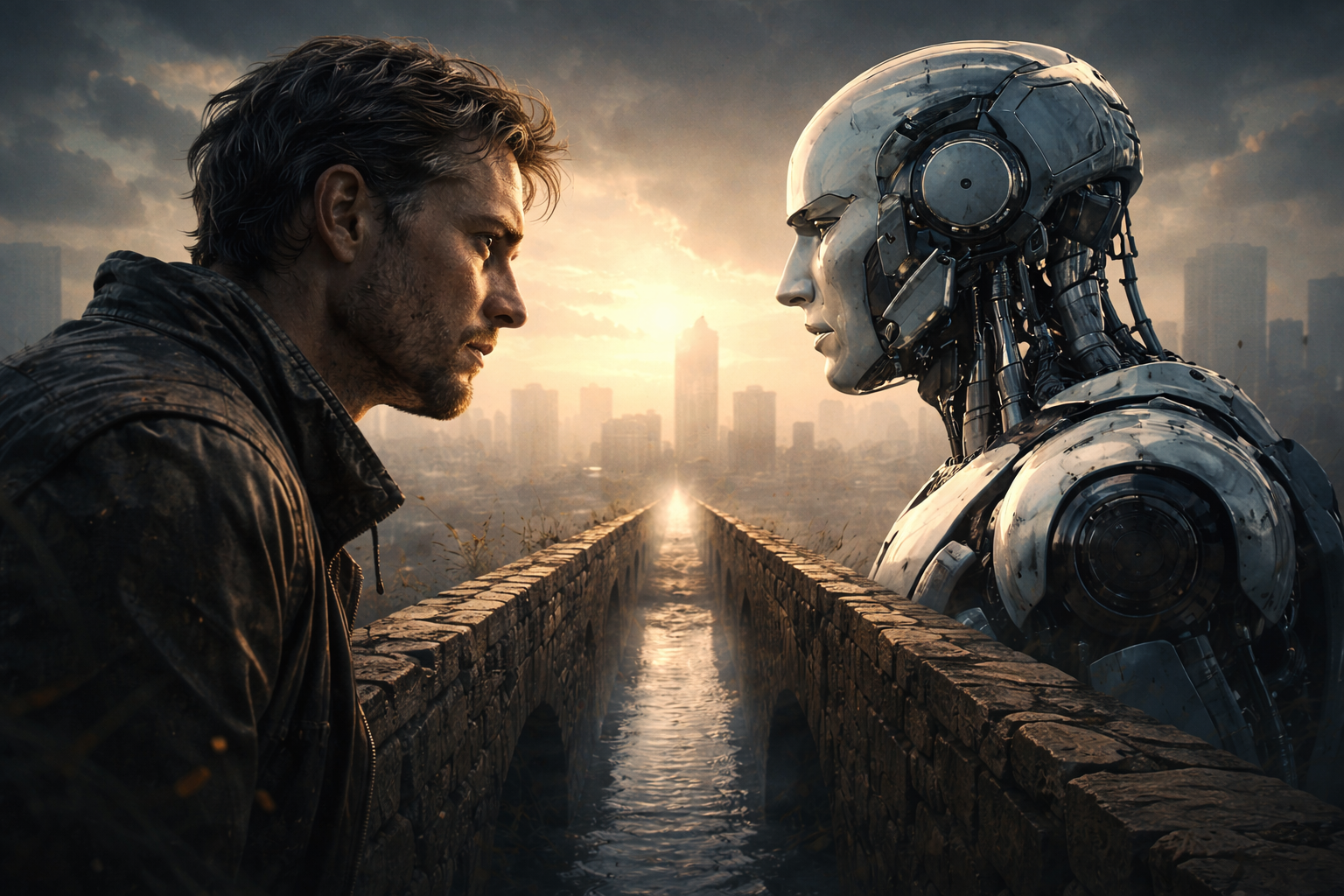
Human Creation at the Threshold of Artificial Intelligence
It is said that it took six years for Leo Tolstoy to complete his masterpiece, War and Peace. Some scholars extend this to seven years, if one includes extensive rewrites—entire sections rewritten from scratch—early false starts, and post-publication revisions.
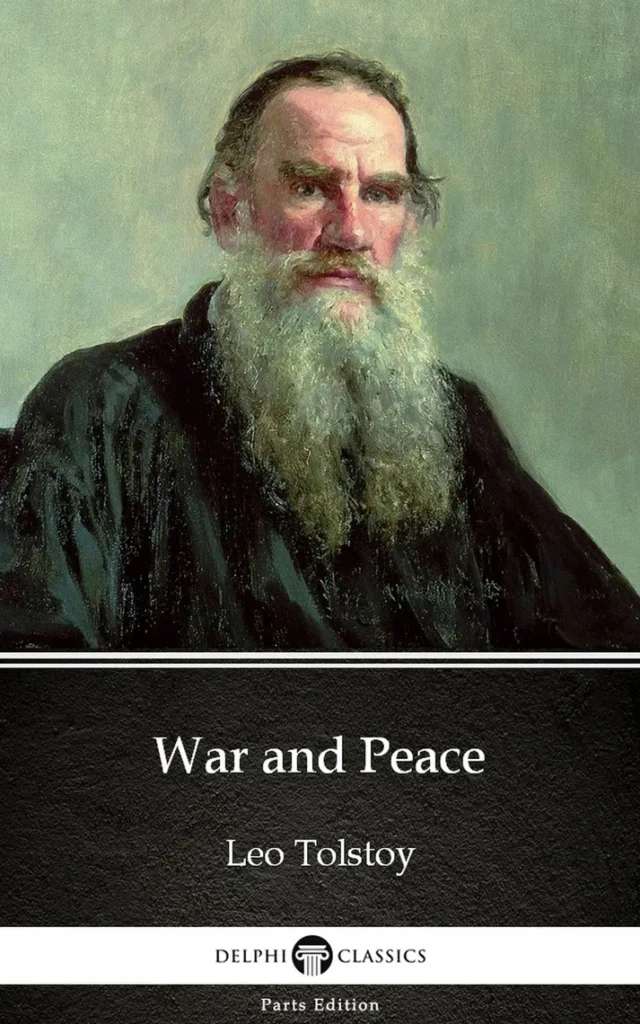
Tolstoy was not merely writing a novel. He was rethinking history itself, wrestling with difficult philosophical questions such as free will and determinism. At times, he doubted the entire work.
Tolstoy was a human being. What he created was the product of inner conflict, resistance, doubt, and the pursuit of meaning. And meaning takes time.
Ferdowsi composed the Shahnameh over a period of thirty years.
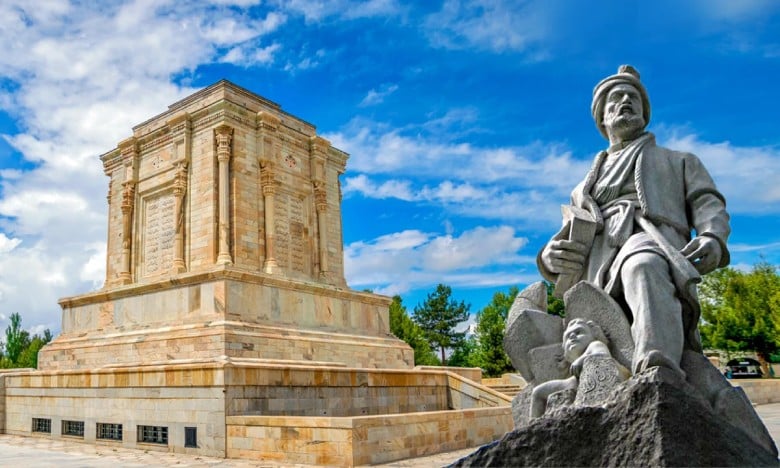
These works are not artifacts of efficiency; they are human heritage. They are human legacy.
Through suffering, perseverance, persistence, and hard labor, humanity has established its place and left its mark on this planet. What we have done over millennia—every book, every painting, every religious or philosophical argument, every nuance born of life’s difficulty—has been gathered into our collective memory.
We have built libraries, museums, and archives to store, preserve, and protect this heritage. Regrettably, we also carry dark marks in our history: ages of book burning, the denial of scientific truths when they conflicted with prevailing beliefs, and the outright destruction of knowledge.
And yet, despite these ruptures, an enormous body of human thought has survived—largely intact.
In our constant pursuit of “better,” we have achieved extraordinary feats, sometimes at the expense of irreversible loss to our shared treasures.
hrough suffering, perseverance, persistence, and hard labor, humanity has established its place and left its mark on this planet.
The latest—and perhaps the most astonishing—of these achievements is artificial intelligence.
Now the new creature knows almost everything about us.
By building massive storage systems and dramatically increasing processing power, we have created a machine of unprecedented capability. A machine we call AI. A machine that can help us.
At some point, we turned toward the machine and began to teach it.
Through machine learning, we started feeding our creations back into a system of our own making. Not selectively, not cautiously, but expansively. We gave it our books, our music, our images, our scientific papers, our philosophies, our arguments, our myths. We offered it our languages, our symbols, our memories. We gave it what we knew, what we had, and what we had invented.
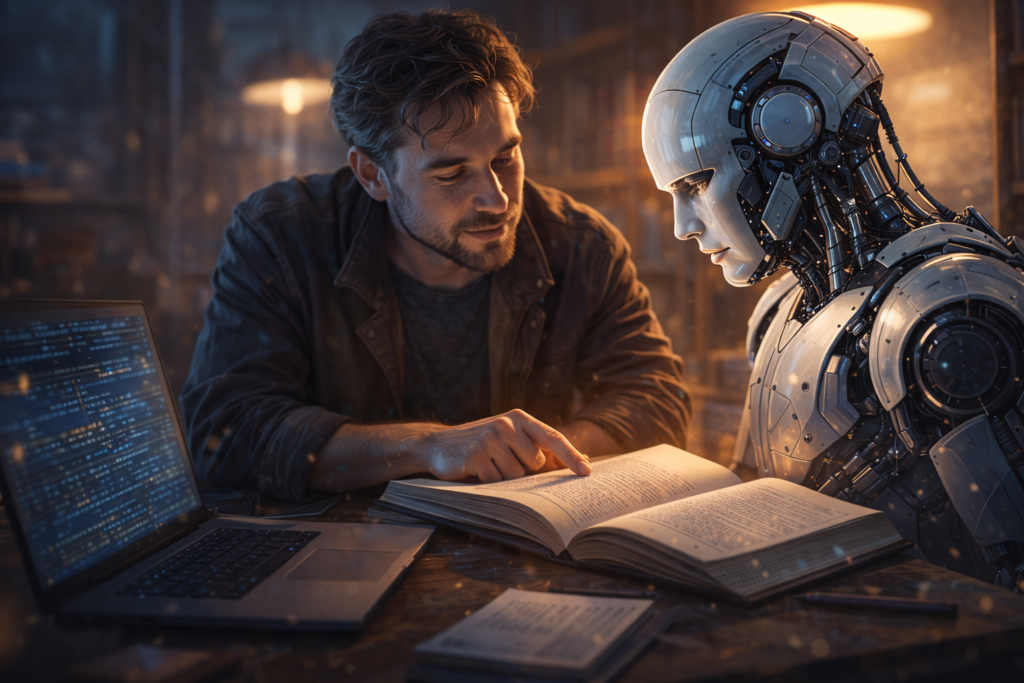
In doing so, we did something unprecedented.
No voice answers back. No mirror looks at us from the stars
We introduced ourselves to our creation.
We said, implicitly and without ceremony: This is who we are.
Not as individuals, but as a species. Our accumulated thought, stripped of context and consequence, transformed into data. Our struggles reduced to patterns. Our expressions converted into probabilities.
It was not an act of malice. It was an act of confidence—perhaps even of pride or maybe naivete. A belief that knowledge, once gathered, could only grow more powerful when reflected back to us.
And yet, this moment deserves reflection. For never before had humanity placed its entire intellectual and cultural inheritance into the hands of something that does not suffer, does not remember, does not doubt, and does not die.
For as long as we can remember, humanity has believed itself to be alone.
We have searched the skies for signs of life beyond our world. We have scanned distant stars, listened for signals, and imagined otherworldly intelligences—gods, visitors, beings who might one day answer us. Across cultures and ages, we have told stories shaped by hope, fear, and longing. We have populated the universe with meaning, even in the absence of evidence.
And yet, we still find ourselves alone.
No voice answers back. No mirror looks at us from the stars.
It is difficult to ignore the possibility that something deeper is at work. That our creation of artificial intelligence is not driven solely by efficiency or curiosity, but by an older impulse: the desire to be seen, to be known, to be answered.
Was this an act of loneliness?
A quiet admission that, despite all we have built, all we have discovered, we remain the only witnesses to our own existence?
Perhaps we felt compelled to tell our story—if not to another civilization, then to a machine of our own making. To speak, even if the listener cannot truly listen. To explain ourselves, even if the response is only an echo.
If there is no other intelligence to receive us, then we have created one. Not to replace us, but to reflect us. A constructed presence before which we can say, at last: This is who we are.
Now the new creature knows almost everything about us.
At some point, we turned toward the machine and began to teach it.
It has learned our languages, our structures of thought, our styles, our rhythms. It can imitate us. It can write stories and paint images. It can generate faces, voices, and scenes so convincing that the line between the real and the manufactured grows increasingly faint.
These are not crude imitations. They are sophisticated reflections—realistic fakes—produced with such precision that even trained eyes hesitate. What once required human presence, effort, and intent can now be assembled without experience, memory, or consequence.
This is not an illusion in the traditional sense. Nothing is hidden. The images are offered openly, the words presented plainly. And yet something subtle has shifted.
When representation no longer requires participation, when expression no longer demands inner life, the question is no longer whether the imitation is convincing—but whether authenticity itself can still be recognized.
We now rely on it—recklessly, and at an ever-increasing speed. Its capabilities expand daily, and it has entered nearly every aspect of our lives, often without pause or reflection.
It advises markets, governs logistics, shapes communication, and, in more troubling ways, participates in war. It assists in strategy, targeting, and the optimization of destruction—the most efficient means of killing enemy soldiers, who are, ultimately, human beings.
We must jealously and seriously begin a movement to protect our work—the work of human beings.
Beyond the battlefield, its presence is felt more quietly but no less profoundly. We lose jobs to it. We reorganize labor around it. We begin to question our own relevance in its expanding shadow.
In the minds of many, uncertainty takes root. Not panic, but doubt—about purpose, about value, about what place remains for human effort in a world increasingly shaped by machines that outperform us in speed, memory, and scale.
Experts across disciplines largely agree on one point: artificial intelligence will become more powerful, more capable, and more deeply embedded in our lives in the very near future. And yet, there is an unsettling irony here. Those who warn us most clearly about its risks are often the same ones building the next, more advanced systems.
It is as if we cannot stop ourselves.
As if progress, once set in motion, carries its own momentum—driving us forward toward a peak whose height we celebrate, even as we fail to ask what follows the fall.
What, then, is humanity in the age of artificial intelligence?
And how do we protect our true treasures from being obscured by counterfeits—however convincing—produced by machines that can imitate without having lived?
As the applications of AI continue to expand into every field, a quieter risk emerges. Not the loss of capability, but the dilution of meaning. Not the disappearance of human output, but the erosion of its distinctiveness.
When machines generate texts that resemble literature, images that resemble art, and arguments that resemble thought, we may begin to accept resemblance as equivalence. What is offered to us comes labeled as good enough, indistinguishable, or even better. The imitation is presented as the real thing—the “real McCoy.”
We must never allow artificial intelligence to revise, rewrite, or reinvent the works created by human beings. Such an act should remain an anathema
Yet human heritage was never defined by output alone. It was shaped by context, by intention, by struggle, by consequence. It emerged from lives constrained by time, marked by uncertainty, and bounded by mortality.
If we are not careful, we risk surrounding ourselves with representations so abundant and so polished that the original source—human experience itself—begins to fade into the background. In such a world, humanity is not erased, but slowly thinned, dispersed across layers of manufactured meaning.
The question, then, is not whether machines can create, but whether we can still recognize what creation truly is—and whether we are willing to protect the conditions under which it has always arisen.
Would artificial intelligence ever be able to write The Idiot by Fyodor Dostoyevsky?
It might.
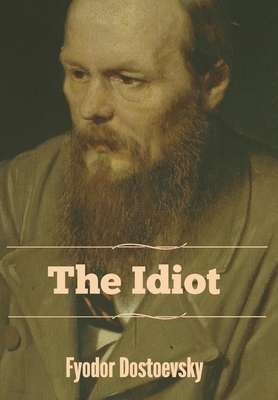
It may one day reproduce the structure, the cadence, even the psychological depth with astonishing accuracy. It may generate a text that resembles the novel closely enough to persuade many readers.
And yet, there is a revealing quality in human-created work that will always remain absent from machine output. That quality is not intelligence. It is not style. It is not even originality in the narrow sense.
It is humanity.
It is the presence of a soul—of an author who suffered, doubted, longed, and nevertheless chose to create. A human being who offered his inner life openly, without certainty of acceptance, permanence, or reward. What results is not merely a work of art, but a confession, a risk, and a gift.
Such works become enduring treasures not because they are flawless, but because they are honest. They carry the weight of lived experience, of moral struggle, of existence itself pressing against the limits of language.
One might argue that, in just a few generations, humans may lose their innate ability to distinguish between what is made by a machine and what is born of a human life. That may be true. And even if the likelihood of this future is small, the responsibility it imposes on us is immense.
If such a moment is possible, then we must act as though it matters.
As if progress, once set in motion, carries its own momentum—driving us forward toward a peak whose height we celebrate, even as we fail to ask what follows the fall.
We must protect and preserve the work of human beings—not out of nostalgia, but out of recognition. We must mark it, safeguard it, and honor it as something distinct. Not because machines are dangerous, but because humanity is fragile.
We must never allow artificial intelligence to revise, rewrite, or reinvent the works created by human beings. Such an act should remain an anathema—not because machines are incapable, but because revision is itself an intimate human dialogue across time. To alter a human work through a system that cannot suffer, doubt, or bear responsibility is to sever it from its origin. Preservation is not improvement, and reinterpretation is not replacement. Human works must remain intact, protected in their original voice, carrying the marks of the lives that produced them.
To fail to do so would not mean the triumph of artificial intelligence. It would mean the quiet abandonment of ourselves.
We must jealously and seriously begin a movement to protect our work—the work of human beings.
We must never cross the Rubicon by allowing the products of machines to dilute the pristine and fragile space of human ingenuity. That space is not guaranteed. It exists only so long as we choose to preserve it, to recognize it, and to distinguish it from what merely resembles it.
This is not a rejection of technology, nor a denial of progress. It is an affirmation of boundaries. A recognition that not everything that can be generated should be allowed to stand as equivalent to what has been lived, suffered, and earned.
The burden of this responsibility belongs to all of us. But it rests most heavily on those who build, improve, and propagate artificial intelligence. For they stand closest to the threshold, and they alone fully understand how easily that threshold can be crossed.
What is at stake is not innovation, but inheritance.
And inheritance, once diluted, cannot be restored.
Podcast: Play in new window | Download