Why Liberation Without Risk Is Not Freedom
William Wallace, Prometheus, and the Illusion of Liberation
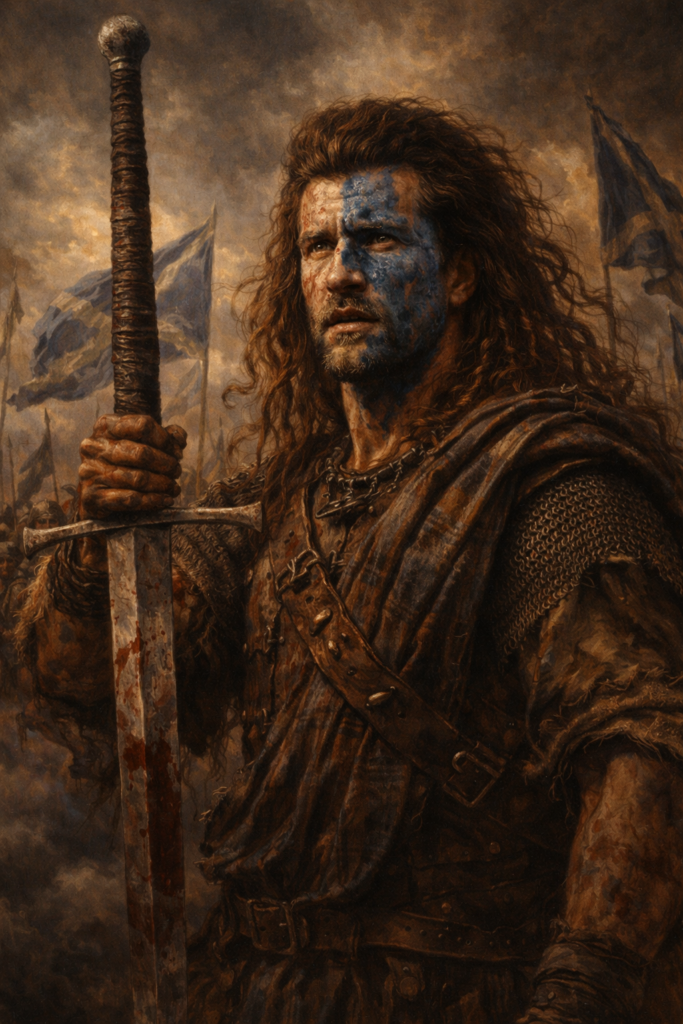
At the end of Braveheart, William Wallace is no longer a political figure. His body is broken, his future erased, his will reduced to a scaffold and a blade. By every modern metric, he is unfree. And yet, with his final breath—just before beheading—he shouts a single word:
Freedom.
This moment resists easy interpretation. Wallace does not die in freedom. He dies for it. Not for his own—he has none left—but for the freedom of others. He gives what he does not possess. He affirms what he cannot enjoy.
This is the first rupture in our understanding. Freedom, here, is clearly not security. It is not safety, continuity, or protection of the body. It is something that survives even when the flesh is fully owned by power.
Freedom, then, may not belong to the body at all.
This essay argues that freedom is not the condition of being protected by systems, but the capacity to act truthfully without guarantee—even at the cost of safety, status, or survival. When freedom is mistaken for security, liberation becomes conditional, and human beings become manageable rather than sovereign.
An Ill-Bound God
“When, on the heights of the Caucasus, Prometheus found that chains, clamps, strait-waistcoats, parapets, and other scruples, had on the whole a numbing effect on him, for a change he turned to the left, stretched his right arm and, between the fourth and fifth hours of an autumn afternoon, walked down the boulevard which leads from the Madeleine to the Opera.”
— Prometheus Illbound, André Gide
Freedom, then, may not belong to the body at all.
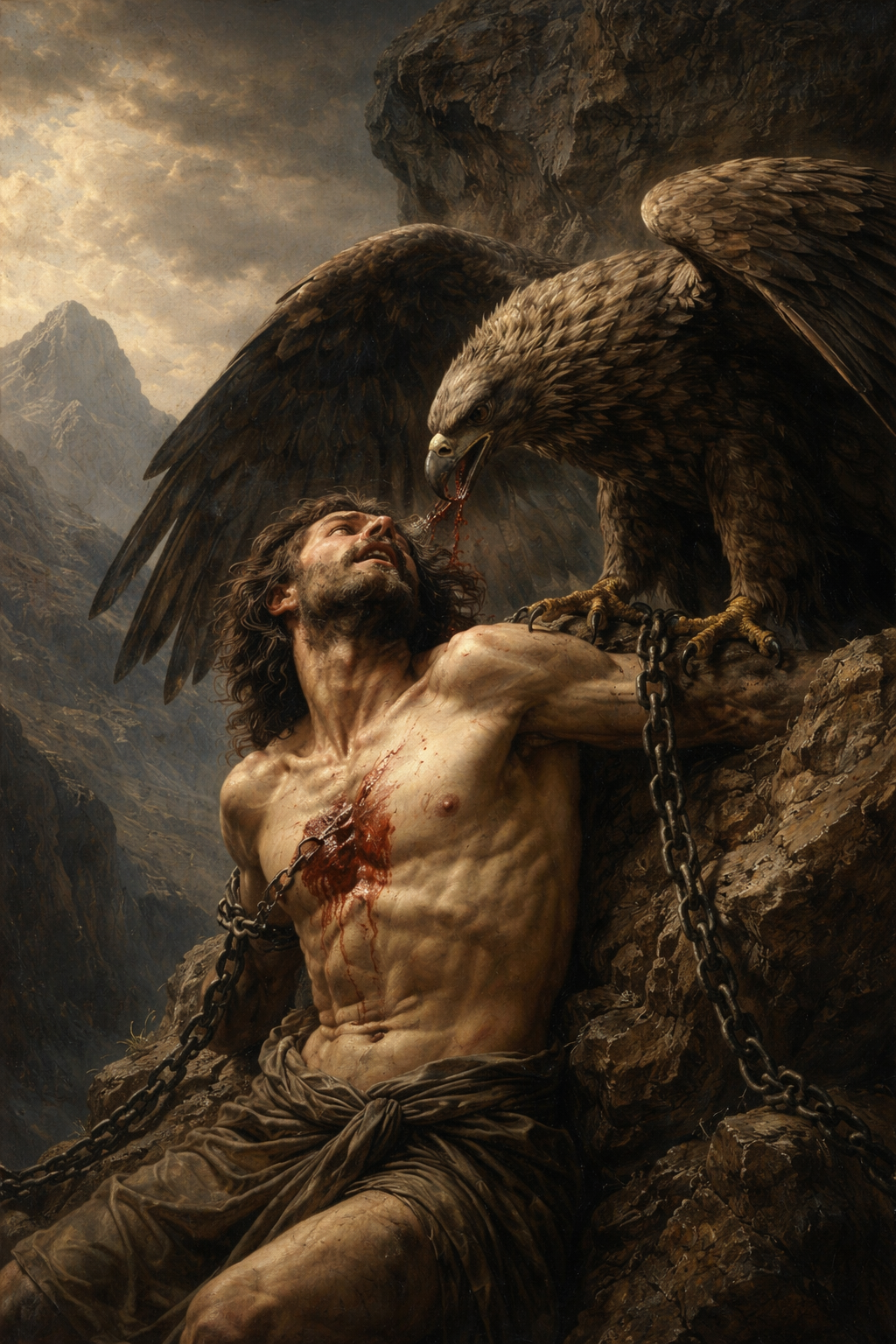
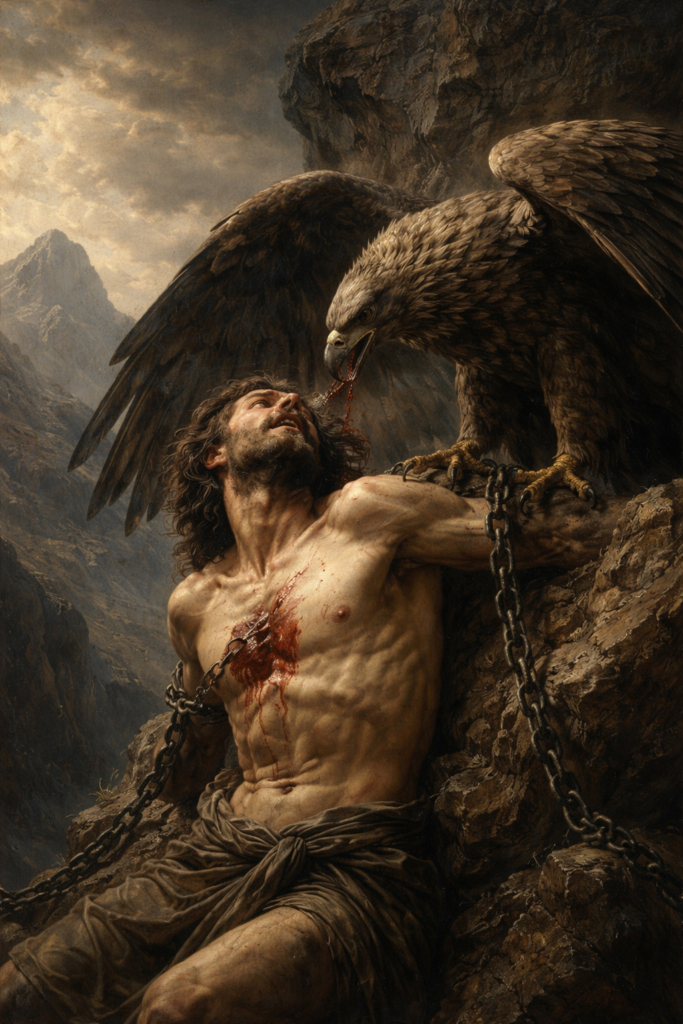
This unsettling realization brings us naturally to Prometheus Illbound, a work that begins where revolutions usually end. Gide’s Prometheus is neither triumphantly liberated nor brutally restrained. He is mal enchaîné—ill-bound, loosely constrained, half-free.
Zeus has not been dramatically overthrown. His authority has simply weakened. The punishment has lost its inevitability. The chains no longer bite as they once did.
And yet, the eagle still feeds.
Gide’s question arrives quietly but decisively:
If the chains are loose, why does bondage remain?
Zeus and the Myth of Absolute Freedom
In classical imagination, Zeus appears to own freedom. He commands, he decides, he is unconstrained. But Gide subtly dismantles this illusion. Zeus’s power exists only through recognition and obedience. His freedom depends entirely on the submission of others.
What masquerades as divine freedom is, in fact, total control.
This inversion matters because it reveals a deeper truth:
Absolute power is not freedom—it is dependency on domination.
The ruler who must be obeyed is never free. His authority binds him as tightly as it binds his subjects.
Was Prometheus Ever Free?
Before his punishment, Prometheus was an insider—trusted, protected, embedded within the ruling elite. By modern standards, he possessed freedom: security, status, immunity.
And yet, he chose to give fire to humanity.
This act was not whimsical. Fire is agency, knowledge, and self-direction. By giving it away, Prometheus risks everything. His so-called freedom vanishes the moment it is exercised against the system that granted it.
Freedom promises nothing
Here we confront a disturbing possibility:
What we often call freedom is merely security granted by a system that oversees society.
Prometheus was not free when he was safe. He became free only when he acted in a way that made safety impossible.
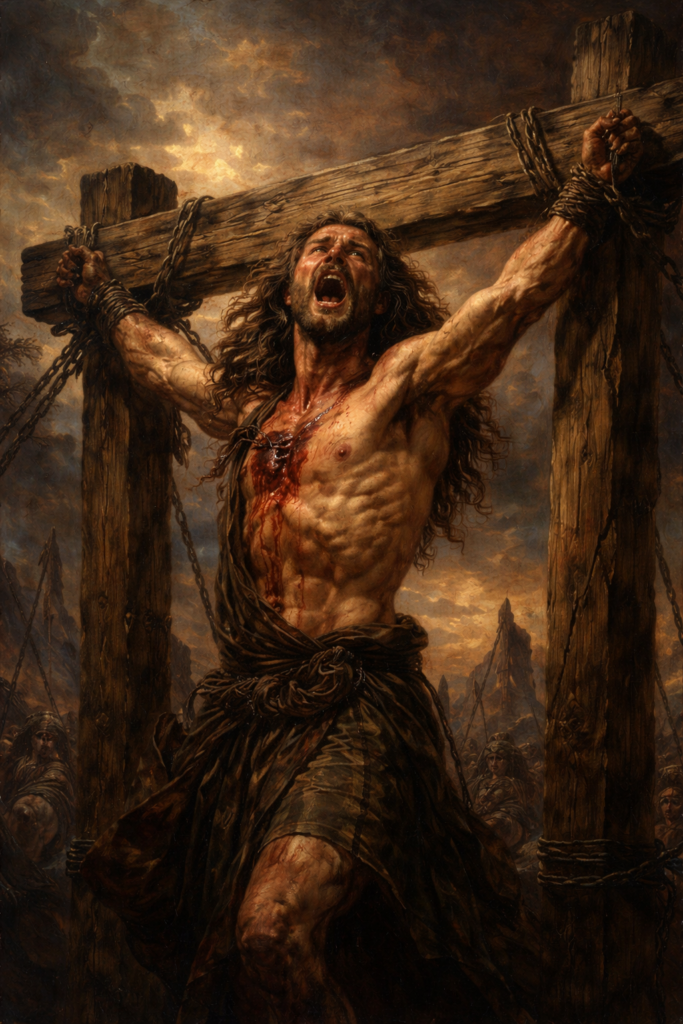
In this, he mirrors Wallace. Both choose freedom before possessing it. Both sacrifice bodily security for a freedom that transcends them. What begins as freedom of mind becomes, through sacrifice, freedom in flesh—not as survival, but as truth made visible.
Freedom Is Not Security
This distinction must now be stated plainly:
Freedom is not to be mistaken for security.
Security can be granted, managed, revoked. It is administered by systems—states, markets, institutions—that oversee behavior. Security promises continuity of life. Freedom promises nothing.
External freedom in the modern age often amounts to conditional security: the permission to move, speak, or choose so long as one remains legible, compliant, and non-threatening to the system that provides it. It exists within legal and social contracts whose withdrawal exposes how little was ever owned.
When that permission is revoked, freedom disappears—because it was never possessed.
Freedom is not boundlessness. It is authorship under constraint—the refusal to outsource meaning even when submission would be easier.
Belief, Chains, and Counterfeit Meaning
A necessary self-critique must be made.
Beliefs are not to be mistaken for chains.
Human beings cannot live without structure, meaning, or orientation. Not all limits are oppressive. Not all commitments enslave.
But Gide exposes a danger with surgical precision:
Counterfeit beliefs build cages—for both body and soul.
These are beliefs:
- Adopted without examination
- Inherited without consent
- Enforced through fear, conformity, or coercion
- Designed to relieve responsibility rather than awaken it
Such beliefs do not merely regulate behavior; they colonize interior life. They teach people to feed the eagle themselves.
The Eagle Reborn: Progress as the New Chain
In Prometheus Illbound, Gide allows Prometheus a moment of terrifying honesty. In his first public speech, Prometheus reveals that the eagle was never merely Zeus’s invention.
It was already waiting.
“Having made men in my image, I understood that in every man there was something hatching; in each one was the eagle’s egg… I was not satisfied with giving them consciousness of existence; I also wished to give them a reason for existence.”
This confession shatters the myth. The eagle is not imposed from above. It emerges from within. Humanity already contains the hunger to be consumed by meaning.
So Prometheus feeds it.
“I gave them Fire… and all the arts which a flame nourishes. By warming their minds, I brought forth the devouring faith in progress.”
Fire becomes reason. Reason becomes technique. Technique becomes progress.
And progress becomes the new eagle.
“No more belief in good, but the morbid hope for better.”
Here Gide delivers his most devastating diagnosis. Good—an ethical anchor rooted in being—is replaced by Better, an endless postponement of meaning. Purpose is no longer found; it is deferred. Humanity is kept moving, optimizing, exhausting itself in the service of a future that never arrives.
Progress does not liberate.
It justifies suffering.
And Prometheus admits he was “strangely happy” watching humanity consume itself in service of it. This is not cruelty. It is recognition.
“Our eagle is our reason for existence.”
The chains have changed form, but they have not disappeared.
Coclès and Damoclès: The Two Ways We Avoid Freedom
Gide does not leave Prometheus alone in bewilderment. He surrounds him with figures who reveal how most people respond to freedom they cannot bear.
Coclès is blind—but his blindness is not merely physical. It is existential. He lives safely, obediently, guided by structures he does not question. He does not ask whether he is free; he asks only whether he is protected.
Coclès represents the modern temptation to confuse freedom with security. He trades sovereignty for supervision.
He is not oppressed.
He is managed.
Damoclès stands at the opposite pole. He is not blind, but anxious. He believes freedom lies in proximity to power—status, recognition, authority. Yet the closer he stands to power, the more fragile he becomes.
Damoclès mistakes power for freedom. His bondage is psychological, not legal. He is free in body, but enslaved in spirit.
Together, Coclès and Damoclès reveal the two dominant strategies for avoiding freedom:
- Submit and be protected
- Serve power and be validated
Both offer security.
Neither offers sovereignty.
Prometheus stands apart because he refuses both blindness and proximity. He chooses neither managed safety nor borrowed authority. He chooses risk without guarantee—and pays for it.
Liberation—and the Problem That Follows
In Prometheus Illbound, the chains loosen. Zeus fades. External domination weakens.
And then—nothing happens.
Prometheus wanders. He hesitates. He continues his ritual suffering voluntarily.
Why?
Because liberation does not teach one how to live with freedom. External chains can fall while internal structures remain intact. Habit, guilt, identity, and the need for coherence persist.
Total freedom—the absence of all bounds—is not liberation. It is dissolution.
Was the exile of Adam and Eve liberation? Or the beginning of consciousness—endowed by creation itself with a yearning they could not yet understand?
Democracy, Majority Rule, and the Smallest Minority
Modern societies define freedom politically: democracy, representation, majority rule. These are real achievements—but they are also constructs.
They contain an unresolved contradiction:
The individual is the smallest minority—yet must submit to the will of the majority, even when that majority is manipulated, anesthetized, or captured.
When the majority is compromised, external freedom becomes procedural. Consent becomes symbolic. Submission becomes normalized.
At that point, freedom collapses into security—and security becomes contingent.
A Direct Answer to Material Critiques
Materialist and Marxist critiques rightly warn that “inner freedom” can be abused as consolation. Hunger, coercion, and inequality are real. No honest account of freedom denies this.
But material liberation presupposes something it cannot generate on its own:
- Recognition of injustice
- Refusal of inner consent
- Willingness to act without guarantee
These are interior acts. Even class consciousness is not material—it is perceptual and ethical.
History shows revolutions that succeed materially and reproduce domination. External chains fall, but the human relationship to authority remains unchanged.
Internal freedom is not a substitute for political freedom.
It is its precondition.
Why Strong Men Return
Freedom is heavy. It demands responsibility without guarantees and meaning without commandments. When societies achieve external freedom without cultivating internal freedom, they grow tired.
The strong man offers relief:
- Order instead of uncertainty
- Direction instead of self-authorship
- Security instead of freedom
This is not always cruelty.
Often, it is exhaustion.
What Freedom Is—and What It Costs
Freedom is not comfort.
Freedom is not safety.
Freedom is not survival.
Freedom is the capacity to act beyond oneself—to affirm meaning before possession, to risk dignity without guarantee, to give what one does not own.
By this measure:
- Wallace dies free.
- Prometheus becomes free when he gives fire.
- Many “free” societies remain ill-bound.
Freedom is not the glorification of suffering. Suffering has no inherent virtue. Freedom lies in the refusal to grant inner consent to domination—even when suffering is imposed externally.
Freedom We Can Bear
Prometheus Illbound does not deny liberation. It denies fantasy.
If liberation means the absence of all bounds, it is impossible. We cannot escape mortality, interdependence, or the need for structure.
True liberation is lucidity:
- Knowing which bounds are inescapable
- Refusing counterfeit beliefs
- Distinguishing freedom from security
- And ceasing to feed the eagle unconsciously
Freedom is not something we arrive at.
It is something we risk—sometimes even before we possess it.
And perhaps the final test of freedom is this:
Would we still choose it, even if all it gave us was the right to stand unbroken?
Podcast: Play in new window | Download